Anchor design in Saanich, British Columbia, operates under a specific geotechnical regime defined by the National Building Code of Canada (NBCC 2020) and CSA A23.3 Annex D requirements for post-tensioned anchors. The municipality sits at the southeastern tip of Vancouver Island, where the bedrock is draped with Vashon till, glaciomarine silts, and occasional Colwood gravel lenses—deposits that can confound standard bond zone assumptions. A routine 15- or 20-meter excavation near the Patricia Bay Highway often encounters a transition from stiff clay to dense till, and that interface is where passive wedge theories need careful calibration. The local practice leans on the FHWA GEC No. 4 guidelines for ground anchors, but the bond stress values get adjusted after site-specific verification testing, because the till here can be denser than textbook values suggest. We rely on CPT testing to profile the overconsolidated silts without disturbing the sample structure, and integrate those tip resistance curves directly into the tendon free-length design.
Bond stress verification in Vashon till often doubles the presumptive values found in older Saanich borehole logs, reshaping the economics of anchor spacing.
Method and coverage
Regional considerations
Saanich's coastal rainfall pattern—averaging 880 mm annually with concentrated November-to-February saturation—aggravates the corrosion risk for permanent anchors. The marine clay layers trap moisture against the tendon sheath, and the high groundwater table in low-lying areas like the Cordova Bay flats means anchor heads often sit in a permanently damp environment. Class I protection becomes non-negotiable. The seismic reality adds another layer: a design earthquake on the Leech River fault could impose cyclic load reversals on the anchor bond zone. If the grout-to-ground interface degrades under those cycles, the load transfers to the passive wedge prematurely. That risk is managed by specifying double-corrosion protection and by running dynamic load tests that simulate the service-life seismic demand. The liquefaction assessment for the site is a prerequisite—anchors socketed into liquefiable layers lose confinement, and the design must either bypass those strata or account for the post-liquefaction strength reduction in the bond length calculation.
Standards that apply
CSA A23.3:2019 Annex D – Anchorage, NBCC 2020 – Structural Commentaries (Earthquake Loads), PTI DC35.1-14 – Recommendations for Prestressed Rock and Soil Anchors, FHWA-NHI-10-016 GEC No. 4 – Ground Anchors and Anchored Systems, ASTM A416/A416M-18 – Strand
Other technical services
Active Anchor System Design
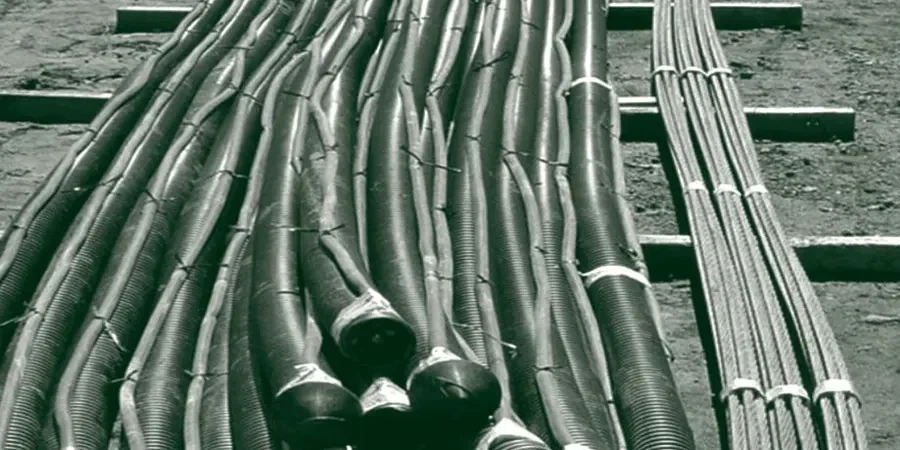
Complete design package for post-tensioned anchors including bond zone calculation in glacial till, free length determination, load transfer analysis, and performance testing protocols per PTI recommendations.
Passive Anchor and Soil Nail Specification
Design of passive restraint systems for temporary excavations and slope stabilization, with pullout capacity derived from site-specific shear strength profiles and field verification testing.
Anchor Corrosion Protection & Monitoring
Specification of Class I or II encapsulation systems, electrical isolation testing, and long-term lift-off test programs to confirm residual load in permanent anchors exposed to Saanich's marine air.
Typical parameters
Quick answers
What bond stress values are realistic for anchors in Saanich's glacial till?
The Vashon till in Saanich often delivers ultimate bond stress values between 350 and 500 kPa based on verification testing, which is substantially higher than the 200 kPa presumptive value still quoted in some older local reports. However, these values are not universal—zones with higher silt content can drop below 250 kPa. Every design should be confirmed with at least three sacrificial test anchors loaded to failure, following the PTI DC35.1 performance test protocol, before finalizing the production anchor lengths.
How does the seismic hazard in Greater Victoria affect anchor design?
The Leech River and Devil's Mountain fault systems contribute to a design peak ground acceleration that can reach 0.3g to 0.4g in parts of Saanich depending on the site class. Anchors must be detailed to accommodate cyclic load reversals without progressive bond degradation. This typically means specifying a longer free length to distribute strain, using ductile tendon steel, and requiring double-corrosion protection for permanent anchors. The seismic demand is evaluated per NBCC 2020 and the site-specific hazard spectrum.
What is the typical cost range for anchor design and testing in Saanich?
The combined design, load testing, and documentation package for anchor systems in Saanich generally falls between CA$1,240 and CA$4,560 depending on the number of anchors, the testing protocol required, and whether permanent corrosion protection is specified. A small temporary excavation with four anchors and two verification tests sits at the lower end, while a permanent tied-back wall with multiple rows, Class I protection, and long-term monitoring approaches the upper range.
Can passive anchors replace active anchors in a deep excavation?
Passive anchors—essentially grouted bars that engage through soil deformation—can work for shallow cuts in competent till, but they are rarely a full substitute for active anchors in deep Saanich excavations. Active anchors apply a preload that limits wall deflection before the soil mass moves, which is critical when adjacent structures or roadways are within the zone of influence. In a 10-meter cut along a busy corridor like McKenzie Avenue, active anchors are typically the primary restraint, with passive elements limited to local stabilization of the facing between anchor rows.