The 2020 National Building Code of Canada (NBCC) sets strict requirements for foundation performance on compressible soils, a condition prevalent across large portions of Saanich. Much of the municipality sits on glacial lake sediments and marine clays deposited during the last retreat of the Cordilleran ice sheet, which means standard shallow footings often fail settlement criteria. Stone column design addresses this directly by constructing dense aggregate columns through the soft strata, transferring load to a stiffer composite ground mass. For sites near Elk Lake or the Patricia Bay Highway where organic silts extend down several meters, our team combines vibro-replacement analysis with a liquefaction assessment to verify post-seismic stability, and where access is constrained, we rely on CPT testing to profile the stratigraphy without disturbing sensitive samples.
In Saanich's marine clay, a well-designed stone column grid typically reduces total settlement by 40 to 60 percent compared to untreated ground, while accelerating consolidation drainage.
Method and coverage
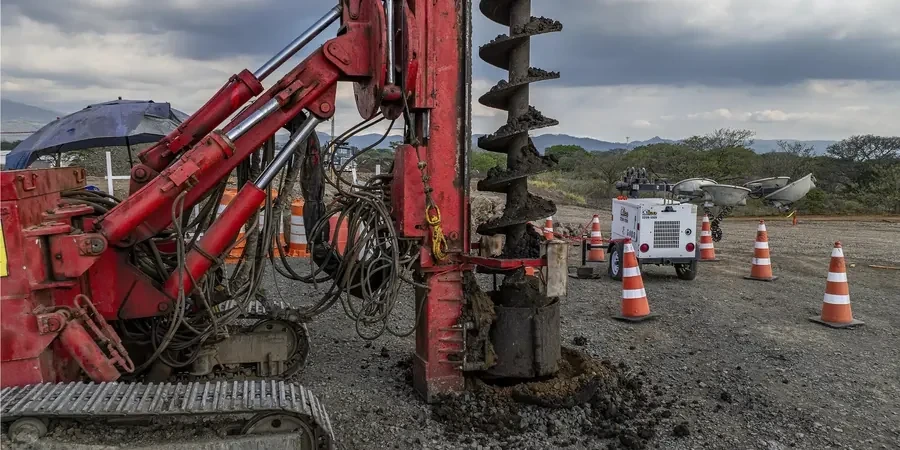
Regional considerations
A recurring mistake on Saanich Peninsula projects is specifying stone columns based solely on SPT blow counts without measuring the sensitivity of the clay. The local marine clays can be moderately sensitive; vibratory insertion without proper pre-drilling or water pressure control can remold the surrounding soil and create a smeared zone that drastically reduces radial drainage. The result is a column that looks correct on the QA/QC log but delivers half the expected stiffness. Another frequent error is ignoring the transition zone between the column tip and the bearing stratum—if the tip sits on a thin dense lens over softer material, differential settlement can punch through. Our stone column design always includes a minimum embedment of one column diameter into competent bearing material, verified by a post-installation CPT sounding through the column center.
Standards that apply
ASTM D6913 / D6913M-17 Standard Test Methods for Particle-Size Distribution (Gradation) of Soils Using Sieve Analysis, NBCC 2020 Division B, Part 4 – Structural Design (foundation provisions), CSA A23.3-19 Design of Concrete Structures (pile cap integration), ASTM D1194-18 Standard Test Method for Bearing Capacity of Soil for Static Load and Spread Footings (plate load verification)
Other technical services
Geotechnical model and column layout
We build a 3D stratigraphic model from CPT and laboratory data, then define the triangular or square grid, column length, and diameter to meet total and differential settlement targets.
Test panel specification and supervision
We prepare the test panel program, monitor the ammeter and stone consumption records on site, and correlate the results with post-panel CPTs to lock in the production parameters.
QA/QC verification plan
Our engineers draft the inspection test plan (ITP) with hold points, specify the frequency of plate load tests per ASTM D1194, and define acceptance criteria for modulus improvement factor.
Integration with shallow footings
We design the load transfer platform—typically a well-graded granular mattress 0.5 to 1.0 m thick—and check punching shear at the column heads under the factored column loads.
Typical parameters
Quick answers
What soil conditions in Saanich make stone columns the right choice?
Soft to firm silty clays and clayey silts with undrained shear strength between 15 and 50 kPa are prime candidates. In Saanich, these are often glacial lake deposits or marine clays where settlement under structural loads would exceed the 25 mm serviceability limit without Improvement.
How long does installation and verification take for a typical Saanich residential lot?
For a single-family lot requiring 20 to 40 columns to 10 m depth, installation usually takes two to three days. The post-installation CPT verification and one plate load test add another day, and the load transfer platform placement follows immediately after acceptance.
Can stone columns be installed close to existing structures on a sloping Saanich site?
Yes, but it requires careful sequencing and vibration monitoring. We specify a minimum setback of 2.5 m from existing footings and often use pre-augering through the crust layer to reduce lateral vibration transmission. Sloping sites demand a staged installation from the downslope side upward to maintain confinement.
What is the typical cost range for stone column design and QA/QC on a Saanich project?
For design, test panel specification, and field verification on a typical Saanich Peninsula project, fees range from CA$1,760 to CA$7,880 depending on the number of columns, depth, and required testing frequency. The installation itself is contracted separately by the owner or general contractor.
What verification testing do you require before signing off on the columns?
We require a minimum of one CPT sounding through a column center per 500 m² of treated area, plus at least one plate load test on a column group per site. The acceptance criterion is an improvement factor n (ratio of treated to untreated modulus) of at least 2.0, measured at the design bearing level.