Ground improvement in Saanich represents a specialized branch of geotechnical engineering focused on modifying the physical properties of native soils and fills to meet the demands of modern construction. The municipality, located on Vancouver Island, encompasses a variety of challenging subsurface conditions, including soft marine clays, loose deltaic sands, and undocumented fill areas, particularly near the coastlines of the Saanich Peninsula and the shores of Elk and Beaver Lakes. These soils often lack the bearing capacity, stiffness, or drainage characteristics required for safe and serviceable structures, making improvement techniques essential for everything from single-family homes to major municipal infrastructure. Without proper treatment, developments on these weak soils risk excessive total and differential settlement, slope instability, and in seismic events, liquefaction—a phenomenon where saturated granular soils lose strength and behave like a liquid.
The geological context of Saanich is dominated by the legacy of the last glaciation and subsequent sea-level changes. Much of the low-lying terrain is underlain by the Vashon till and Capilano sediments, which include thick sequences of glaciomarine stony clay and silt, often overlain by softer post-glacial deposits. In valley bottoms and along the coastline, compressible organic silts and peats are frequently encountered, presenting significant challenges for foundation design. Additionally, areas with loose, saturated sands, such as those found in the Cordova Bay and Cadboro Bay regions, are susceptible to seismic shaking given Greater Victoria's position within the seismically active Cascadia Subduction Zone. Understanding this local geology is the first step in selecting an appropriate ground improvement strategy, as the performance of any technique is intrinsically linked to the soil's grain size distribution, density, and groundwater conditions.
Regulatory compliance in Saanich, as throughout British Columbia, is governed primarily by the BC Building Code, which references the National Building Code of Canada and the Canadian Foundation Engineering Manual. For seismic design, the code mandates site-specific ground motion assessments and classifies sites based on their soil properties, often requiring improvement to prevent liquefaction for Site Class F or E soils. The District of Saanich's own bylaws and development permit processes typically require a Professional Engineer registered with Engineers and Geoscientists BC (EGBC) to design and oversee all ground improvement works. Geotechnical investigations must conform to CSA-A23.3 and ASTM standards for drilling, sampling, and testing. A common requirement is the submission of a detailed geotechnical report demonstrating that post-improvement soils will meet specified performance criteria for settlement, bearing capacity, and seismic response, ensuring the safety and longevity of the built environment.
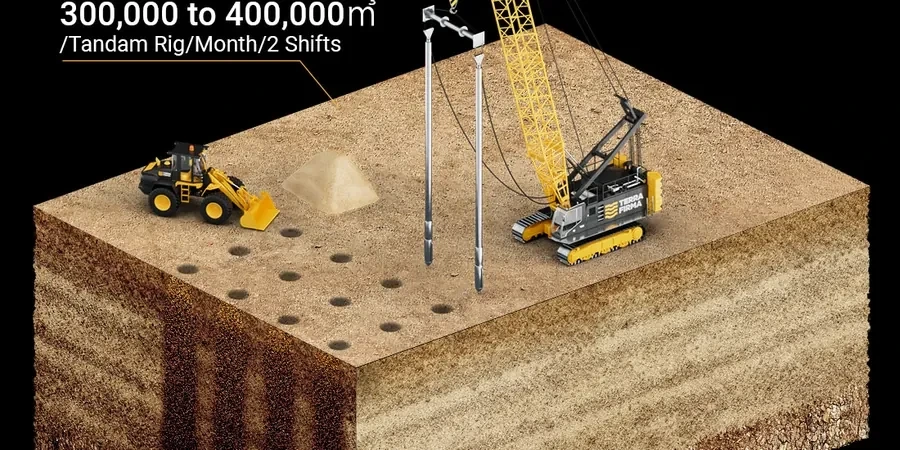
The range of projects requiring ground improvement in Saanich is broad. Residential developers on the peninsula frequently encounter soft organic soils that necessitate preloading with wick drains or rigid inclusion systems. Commercial and light industrial buildings in areas like the Keating Cross Road corridor often rely on advanced methods to support heavy floor loads on loose fills. Critical infrastructure, including ferry terminals, retaining walls along the Patricia Bay Highway, and municipal water treatment facilities, demands robust solutions like stone column design to reinforce weak cohesive soils and offer drainage paths. For granular deposits with high liquefaction potential, vibrocompaction design is a widely adopted method to densify soils in situ, effectively mitigating the risk of seismic-induced ground failure. These techniques, along with deep soil mixing and compaction grouting, form the core toolkit for geotechnical engineers working in this seismically and geotechnically complex region.
Available services
Quick answers
What is ground improvement and when is it necessary in Saanich?
Ground improvement encompasses engineering techniques that alter soil properties to increase strength, reduce compressibility, or mitigate liquefaction risk. In Saanich, it becomes necessary when native soils—such as the soft marine clays of the Colwood Delta or loose sands in Cordova Bay—cannot support structural loads without excessive settlement or pose a seismic hazard, as identified in a geotechnical investigation conforming to the BC Building Code.
How do local soil conditions in Saanich influence the choice of a ground improvement method?
The method is dictated by the soil's grain size and saturation. Fine-grained, cohesive clays prevalent in Saanich's lowlands are often treated with stone columns or preloading to accelerate consolidation. Conversely, loose, saturated granular deposits found near former shorelines are ideal candidates for vibrocompaction, which densifies the soil matrix to prevent earthquake-induced liquefaction.
What role does the BC Building Code play in ground improvement projects?
The BC Building Code, referencing the National Building Code, sets seismic site classifications and performance standards that often mandate ground improvement for weak or liquefiable soils. A registered Professional Engineer must design the treatment, and the District of Saanich requires a detailed report demonstrating that the improved ground meets specific bearing capacity, settlement, and seismic resilience criteria before issuing a building permit.
Can ground improvement completely eliminate the risk of earthquake damage to my property in Saanich?
While ground improvement, such as vibrocompaction or stone columns, significantly reduces the risk of liquefaction and structural settlement during a seismic event, it cannot commit to a damage-free outcome. It is designed to meet code-specified performance levels, typically preventing life-safety hazards and structural collapse. Superficial cracking or minor settlement may still occur, but catastrophic foundation failure is effectively mitigated.