Saanich’s growth from scattered farmsteads into the largest municipality on Vancouver Island hasn’t been kind to every foundation. What looks like decent glacial till on a real estate flyer often turns out to be loose silt lenses or saturated marine clay once the backhoe opens the ground—and neither forgives a poorly compacted lift. That’s where the field density test becomes the gatekeeper nobody remembers to thank. Our lab runs the sand cone method straight off the tailgate across all four corners of the Peninsula, from Broadmead’s rocky benches to the old lake-bottom soils near Swan Lake, giving project managers the one number that determines whether the next load of fill goes down or gets ripped out. With a mean annual rainfall pushing 900 mm and a climate that cycles between October soak and August bake, Saanich compaction windows are short; we’ve learned to move fast without cutting the procedure short.
Compaction isn’t about making dirt heavy—it’s about locking out settlement before the roof goes on. A sand cone test gives you that lock.
Method and coverage
Regional considerations
The contrast between Saanich’s western uplands around Prospect Lake and the low-lying basins near Blenkinsop Valley makes the same spec book read completely differently. Up in the till-dominated west, density issues usually trace back to oversized cobbles messing with the sand cone excavation, so we shift to a larger plate and sometimes pair the test with a grain size analysis to confirm the fill gradation hasn’t drifted. Down in the valley, where the water table sits within a metre of grade from November through March, the risk flips to excessive moisture sabotaging compaction—you can run a sheepsfoot roller all morning and still not break 92 percent if the soil’s above optimum. A contractor who skips field density verification in those saturated silts learns about differential settlement the hard way, usually through cracked partition walls about eight months after occupancy. We’ve also seen municipal pavements fail early along McKenzie Avenue where subgrade density was signed off on visual alone; the repair invoices ran well into five figures and the root cause was a single lift that never got a sand cone check.
Process video
Standards that apply
ASTM D1556-15e1: Standard Test Method for Density and Unit Weight of Soil in Place by the Sand-Cone Method, ASTM D698-12e2: Standard Test Methods for Laboratory Compaction Characteristics of Soil Using Standard Effort, BC MoTI Standard Specification Section 2: Grading and Subgrade Preparation
Other technical services
In-Place Density by Sand Cone (ASTM D1556)
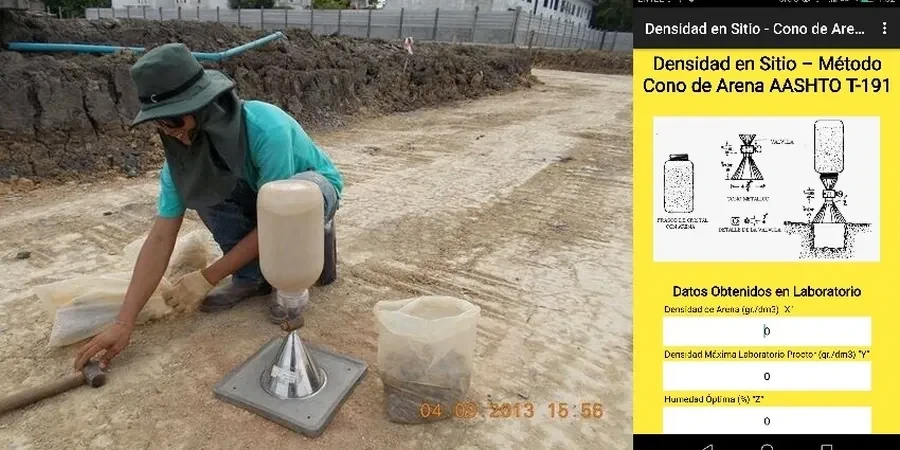
Direct measurement of in-place wet density, dry density, and compaction percentage on structural fill, utility trench backfill, subgrade, and aggregate base. We carry calibrated sand jars, field ovens, and scales to the site; results are called out to the superintendent before we pack up. One test per lift per frequency, with a stamped report issued same day.
Laboratory Compaction Curves (Proctor)
Standard and modified Proctor testing (ASTM D698 / D1557) on borrow source samples so the field density numbers have a meaningful reference. We’ll run a one-point verification on site if the fill source changes mid-project—common in Saanich subdivisions where imported granular borrow arrives from multiple pits on the Island.
Typical parameters
Quick answers
How much does a field density test with the sand cone method cost in Saanich?
For most single-family and light commercial jobs in Saanich, a sand cone density test runs between CA$150 and CA$230 per test, depending on drive distance, number of tests on the same visit, and whether we process the moisture content in the field or back at the lab. Volume discounts apply for larger subdivision or road contracts; ask for a project-rate schedule.
When does Saanich’s building department require sand cone density testing?
Saanich Engineering generally triggers compaction testing under Part 7 of the BC Building Code and the municipal subdivision bylaw whenever structural fill exceeds 300 mm in thickness, when engineered fill is placed under footings or slabs, or when utility trench backfill falls within a public right-of-way. The project’s geotechnical engineer sets the exact frequency, but the municipality will want a stamped compaction report before issuing a foundation inspection pass or final occupancy.
Can you run the sand cone test in wet weather?
Light rain we can work around by tenting the test area and using a field oven to dry the excavated soil immediately. Heavy, sustained Saanich winter rain that saturates the fill usually means the soil is above optimum moisture anyway, so we’ll recommend pausing compaction until conditions improve—testing in the mud just produces a number that confirms what you already know.
What’s the difference between a sand cone test and a nuclear density gauge?
A nuclear gauge gives you density and moisture in minutes using gamma radiation backscatter, but it requires a radioactive materials license, regular calibration blocks, and operator certification under CNSC regulations. The sand cone method is purely volumetric and gravimetric—no radiation, no license, and it serves as the referee method when nuclear gauge readings are disputed. The trade-off is that a sand cone test takes about 15–20 minutes to excavate and process versus two minutes for a gauge.
How many sand cone tests will my project need?
The number depends on the fill volume, lift thickness, and the geotechnical engineer’s testing frequency table. A typical Saanich single-family lot with a compacted building pad and trench backfill might need 4–8 tests. A multi-building townhouse development or a municipal road reconstruction can easily require 50–150 tests over the duration of earthworks. We’ll quote a per-visit minimum and scale from there so you’re not paying for tests you don’t need.