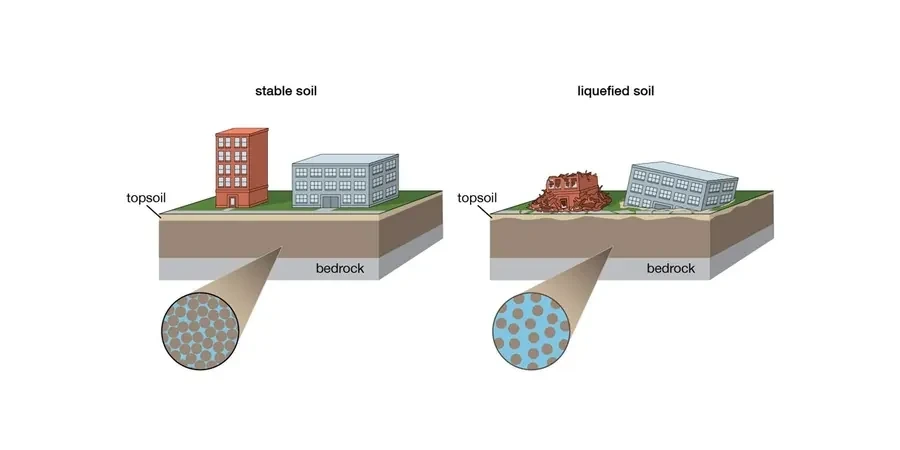
The contrast between Saanich's rolling sedimentary uplands and the soft marine silts near the Gorge Waterway couldn't be starker when it comes to seismic risk. A site on the glacial till around Mount Douglas might perform very differently than one on the alluvial deposits of the Colquitz River floodplain. We run liquefaction analyses that account for these local variations because a standard screening won't capture what's happening 10 meters down in a silty sand lens that saturates each winter. The [Saanich Official Community Plan](https://www.saanich.ca) recognizes seismic hazards, but translating that into a buildable site requires granular data. Our team coring through these deposits has seen how quickly soil behavior can change from one block to the next, and that's precisely why our approach integrates site-specific groundwater monitoring with standardized penetration testing data.
A saturated sand in Saanich can lose 80 percent of its bearing capacity within seconds of shaking. That's not theoretical—it's what the NCEER curves predict for our local fines content.
Method and coverage
Regional considerations
The drill rig we mobilize for liquefaction assessment in Saanich is a compact track-mounted unit that can reach 20 meters without turning your site into a mud pit, which matters when you're working on a residential lot in Gordon Head with 5 meters of side yard. The crew sets up over the target location and begins advancing a hollow-stem auger while recording blow counts every 150 millimeters. In the saturated zones below 3 or 4 meters, where the cuttings come up wet and grey, we switch to a larger sampler and slow the advance rate to avoid disturbing the very soil structure we need to evaluate. Every sample jar gets sealed immediately because the moisture content in these silts can drop by 2 percent just from the morning sun hitting the container. The rig operator reads the hydraulic pressure gauge constantly; a sudden drop signals a loose layer that might trigger a low N-value, and that's the zone where we'll run additional thin-walled tube sampling for the cyclic triaxial program back at the lab.
Process video
Standards that apply
NBCC 2020 Seismic Hazard Provisions, ASTM D5311/D5311M-13 (Cyclic Triaxial), NCEER/Youd-Idriss 2001 Consensus, AASHTO T-206 (SPT Correction), ASTM D1586-18 (Standard Penetration Test)
Other technical services
SPT-Based Liquefaction Screening
We execute standard penetration tests with calibrated energy delivery, correcting N-values to N1,60 according to AASHTO T-206. This data feeds directly into the simplified procedure for calculating cyclic stress ratios and factors of safety, providing a clear pass/fail assessment for each potentially liquefiable layer encountered in the boring.
Cyclic Triaxial Testing
Undisturbed samples collected from saturated zones in Saanich undergo cyclic loading in our lab to determine the actual cyclic resistance ratio (CRR). This eliminates the uncertainty that comes from fines-content correction in SPT-based methods, especially in the transitional silty sands common near the Saanich Inlet.
Post-Liquefaction Settlement & Lateral Spread Analysis
Beyond the factor of safety, we calculate the expected vertical settlement using Tokimatsu-Seed and Ishihara-Yoshimine volumetric strain models. For sites with a free face toward a slope or waterway, we also evaluate lateral spreading displacement using the empirical models from Bartlett & Youd (1992) to quantify the risk to deep utilities and access points.
Typical parameters
Quick answers
How long does a liquefaction analysis take for a single-family home lot in Saanich?
The field drilling and SPT logging typically require one full day on site. We then need approximately 10 to 12 business days for the lab to complete cyclic triaxial testing on the selected samples and for our engineering team to prepare the final report with settlement estimates and foundation recommendations.
What does a liquefaction study cost for a residential project in Saanich?
For a standard residential lot requiring one borehole with SPT logging and a cyclic triaxial test program, the analysis generally runs between CA$3,550 and CA$6,200. The final cost depends on access conditions, the depth of the borehole, and the number of samples selected for lab testing.
Can you determine if my Saanich property requires a liquefaction assessment under the current building code?
We start with a desktop review of the surficial geology mapping and the seismic site class. If Quaternary alluvial deposits or marine silts are mapped on your parcel, or if the water table is within 3 meters of the foundation level, the NBCC typically triggers the need for a site-specific assessment. We'll confirm this before any drilling begins, saving you from unnecessary work if the site classifies as rock or dense till.
What's the difference between an SPT-based assessment and a CPT-based one for liquefaction?
The SPT method allows us to recover a physical sample so we can measure fines content and plasticity directly, which is critical in Saanich because the silts here can have fines contents between 15 and 40 percent. A CPT gives a continuous profile and is faster, but it can't directly measure the plasticity index, so you must rely on soil behavior type correlations. We often run SPT for the primary borehole and use CPT soundings to fill in the stratigraphy between holes on larger commercial sites. More info.