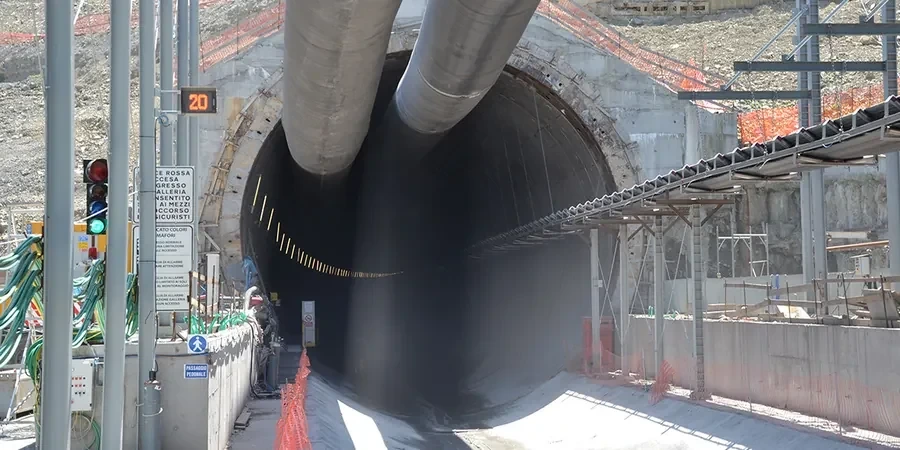
Saanich spans two very different geologies. Bedrock is shallow across the Cordova Bay uplands, but drop south toward the Haro Strait shoreline and you hit 30 meters of marine clay and glacial till before seeing anything competent. Tunneling through that transition zone demands a different analytical approach at every chainage. Our team runs the CPT testing program and laboratory triaxial suites needed to map strength contrasts across these boundaries, so the excavation method and support class match the ground actually present — not what the regional map assumes.
In Saanich's glacial-marine sequence, the distance between stable face and collapse can be less than 15 meters. Ground characterization must match that resolution.
Method and coverage
Regional considerations
Saanich sits at roughly 23 meters elevation on average, with a water table that often sits within 2 meters of surface from October through April. That changes everything for soft-ground tunneling. Face instability is not a theoretical risk; it is a wet-season construction reality. The District of Saanich has recorded groundwater fluctuations exceeding 1.5 meters between summer and winter monitoring periods. Combine that with the sensitive marine clays mapped across the lowlands, and you get a soil that remolds on contact with excess pore pressure. Face loss, crown settlement, and utility strikes become predictable when the ground model ignores seasonal saturation. We design the monitoring plan and pre-support to match those conditions.
Process video
Standards that apply
ASTM D4767 – Consolidated-Undrained Triaxial, NBCC 2020 Part 4 – Structural Design, CSA A23.3 – Concrete Structures, ASTM D2488 – Visual-Manual Soil Description
Other technical services
Soft Ground Tunnel Design Parameters
Full geotechnical characterization from field investigation through laboratory testing. Includes CPTu profiling, triaxial CIU/CAU testing, consolidation analysis, and 2D/3D numerical modeling for face stability and crown settlement prediction in Saanich’s glacial-marine soils.
Construction-Phase Ground Monitoring
Instrumentation design and data interpretation for tunnel drives. We specify extensometers, piezometers, and surface settlement arrays, then track deformation against threshold values defined from the ground model.
Typical parameters
Quick answers
What is the typical cost range for a soft-ground tunnel geotechnical investigation in Saanich?
Investigation programs for Saanich soft-soil tunnel projects typically range from CA$6,220 to CA$24,050, depending on the number of boreholes, depth of sampling, and the laboratory testing suite required. A short utility tunnel with two CPT soundings and basic triaxial tests sits at the lower end; a longer alignment through variable glacial-marine deposits with full instrumentation design reaches the upper range.
How do you handle the high water table during tunnel design in Saanich?
We model groundwater as a primary load case, not an afterthought. Our investigation measures in-situ permeability and pore pressure response through CPTu dissipation tests and standpipe piezometers. The design then includes dewatering or groundwater control measures specific to the seasonal high stand recorded in Saanich District monitoring wells.
What makes Saanich soils challenging for tunneling?
Saanich’s lowland areas contain thick sequences of sensitive marine clay and glacial till with high water content. These soils lose significant strength when disturbed, which creates face stability and settlement risks. Our analysis quantifies that sensitivity and specifies excavation methods and support timing that limit ground loss.