The complex glacial stratigraphy beneath Saanich, shaped by the Cordilleran ice sheet and subsequent marine inundation, presents soils ranging from dense Vashon till to compressible glaciomarine silts. With a population exceeding 114,000, development on the Saanich Peninsula demands precise shear strength parameters that standard index tests cannot provide. A triaxial test on undisturbed samples from this region frequently reveals effective friction angles that differ significantly from empirical correlations, particularly where the local Colwood gravelly sands interfinger with silt layers. Our team performs consolidated-undrained and consolidated-drained triaxial tests to support foundation design, slope stability analysis, and excavation shoring across Saanich, ensuring that every strength envelope reflects the actual pore pressure response of the deposit. Where granular layers dominate, we often pair this with an SPT drilling program to correlate penetration resistance with the laboratory-derived strength profile.
Effective stress strength from a triaxial test on Saanich glaciolacustrine clay often plots well below total stress envelopes, a distinction that governs excavation stability.
Method and coverage
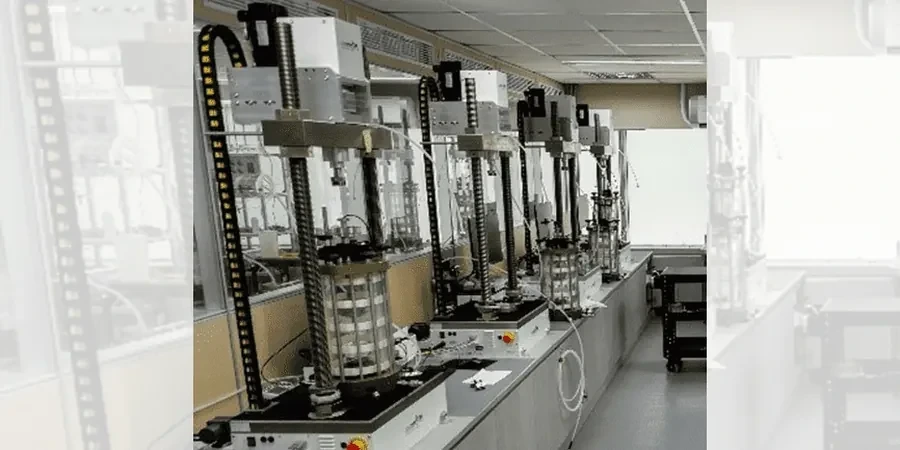
Regional considerations
The 2015 National Building Code of Canada assigns Saanich a Site Class ranging from C to E, depending on the thickness of soft marine clays overlying till. When a triaxial test is omitted, consultants must rely on SPT N-value correlations that were developed for soils outside the Georgia Depression, introducing uncertainty into the seismic site response and liquefaction triggering assessment. The undrained shear strength of a sensitive glaciomarine silt from Saanich can degrade by more than 70% under cyclic loading, a behavior that only a cyclic triaxial test can quantify reliably. Underestimating pore pressure buildup in these deposits risks bearing capacity failure or excessive lateral spread during a design-level earthquake. The cost of a triaxial testing program in Saanich is minor compared to the liability of designing a foundation or retaining wall with unconservative strength values derived from generic tables.
Process video
Standards that apply
CSA + ASTM D2850 (UU triaxial), ASTM D4767-20 (CU with pore pressure measurement), NBCC 2015 seismic site classification, CSA A23.3 Annex A (geotechnical input for concrete structures)
Other technical services
Consolidated-Undrained (CU) with Pore Pressure
Measures effective stress friction angle and cohesion intercept for Saanich silts and clays. Includes Skempton B-value saturation check and multiple confining stress stages.
Unconsolidated-Undrained (UU) Quick Shear
Provides total stress strength for short-term bearing capacity calculations in low-permeability glaciomarine deposits common across the peninsula.
Cyclic Triaxial for Liquefaction Assessment
Applies sinusoidal axial loading at frequencies of 0.1 to 1 Hz to determine the cyclic resistance ratio of saturated sands and silts in Saanich.
Typical parameters
Quick answers
What is the typical turnaround time for a triaxial test suite in Saanich?
A standard three-specimen CU triaxial suite on Saanich soils usually requires 10 to 14 business days from sample extrusion to final report. The timeline reflects the low hydraulic conductivity of local glaciomarine silts, which need extended saturation and consolidation stages to achieve B-values above 0.95. Expedited schedules are possible when fewer confining stresses are requested.
How much does a triaxial testing program cost for a Saanich project?
A standard three-point CU triaxial program with pore pressure measurement typically ranges from CA$2,680 to CA$3,480, depending on specimen preparation effort and required confining stress levels. Cyclic triaxial testing is quoted separately because of the longer loading sequences and additional reporting involved.
What confining stresses should be used for a Saanich foundation design?
Confining stresses are selected to bracket the in-situ effective overburden pressure at the sampling depth, plus the anticipated stress increase from the structure. For a typical two-storey building on Saanich till with a footing depth of 1.5 m, effective confining stresses of 50, 100, and 200 kPa often define the strength envelope well.