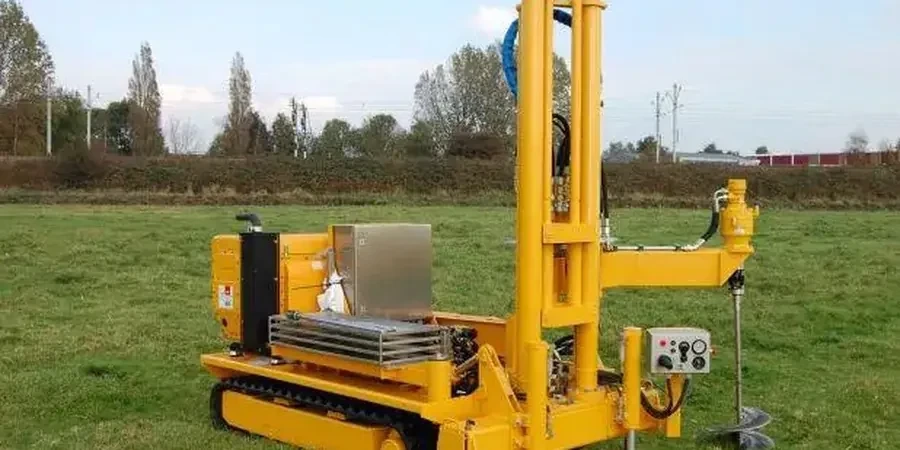
The 20-tonne CPT rig arrives on a tracked carrier, its hydraulic rams ready to push a 15 cm² cone through Saanich’s complex glacial stratigraphy at a constant 2 cm/s. A porous filter element behind the cone tip captures pore-water pressure in real time, while an inclinometer ensures the string stays within 2 degrees of vertical through interbedded till and marine clay. This isn’t a sampled boring—it’s a continuous geotechnical log, delivering tip resistance, sleeve friction, and dynamic pore pressure every centimetre. On the Saanich Peninsula, where Cordilleran ice-sheet deposits sit beside the Haro Strait, the rig often works within metres of the shoreline, pushing to refusal in dense Vashon till while recording the subtle transitions that define seismic site class. We run our cones through a daily calibration sequence before each shift, and the data feeds directly into liquefaction triggering analyses using the Robertson (2009) method, essential where loose marine sands underlie the District’s waterfront neighbourhoods.
In Saanich’s glacial stratigraphy, friction ratio is often the first signal of a transition from Quadra Sand to overconsolidated Vashon till—a boundary that governs pile refusal depth.
Method and coverage
Regional considerations
The maritime climate of southern Vancouver Island introduces challenges that a purely geotechnical spec sheet can’t capture. Saanich averages over 800 mm of annual precipitation, concentrated in winter months when the water table rises within the near-surface sands of the Quadra formation. Pushing a cone through saturated, loose sand without adequate pore-pressure monitoring can mask a thin liquefiable layer that becomes unstable during a Cascadia subduction event. The District sits within Seismic Hazard Zone 5 under NBCC 2020, with a 2% in 50-year spectral acceleration exceeding 0.6 g at short periods. A CPT log that misses a 40 cm silt seam—undetectable by SPT spoon recovery—can shift the site class from C to E, altering the design base shear by a factor of two. We have seen this exact scenario on projects near Cordova Bay, where interbedded marine silts and sands create sharp impedance contrasts. Running a full seismic CPT with dissipation tests at every stratum change is the only way to build a defensible liquefaction profile for the geotechnical engineer of record.
Standards that apply
ASTM D5778-20 – Standard Test Method for Electronic Friction Cone and Piezocone Penetration Testing of Soils, NBCC 2020 – National Building Code of Canada (Seismic Hazard, Site Classification), CSA A23.3:19 – Design of Concrete Structures (Foundation References), Robertson & Cabal (2015) – Guide to Cone Penetration Testing (Gregg Drilling)
Other technical services
Seismic CPT (SCPTu) for Site Classification
Full piezocone with downhole shear-wave velocity measurement every 0.5 m. Delivers Vs30 and site class per NBCC Table 4.1.8.4.A. Critical for multi-storey and institutional buildings in Saanich’s seismic environment.
Piezocone with Dissipation Testing
Standard CPTu with pore-pressure dissipation tests at engineer-specified depths. Provides t50 and estimated coefficient of consolidation for settlement analysis in the compressible clays of the Colquitz and Tod Creek floodplains.
Liquefaction Triggering Analysis Package
CPT-based liquefaction assessment using the Robertson (2009) and Boulanger & Idriss (2014) methods. Includes factor of safety profiles, post-liquefaction volumetric strain, and lateral spreading displacement estimates for waterfront and marine-proximal sites.
Typical parameters
Quick answers
How deep can you push a CPT cone in Saanich's glacial till?
In the dense Vashon till underlying much of the Saanich Peninsula, our 200 kN rig typically reaches refusal between 18 and 30 metres, depending on the degree of overconsolidation and the presence of cobbles. Where the till cap is thin and underlain by softer glacial marine sediments, we can reach depths exceeding 40 metres in a single push. We monitor sleeve friction and pore pressure continuously to anticipate refusal before damaging the cone tip.
What does a CPT test cost for a standard residential site in Saanich?
For a typical single-family residential lot in Saanich, CPT testing ranges from CA$240 to CA$330 per sounding location, which includes mobilization, the push to refusal or target depth, corrected digital logs, soil behaviour type classification, and a brief interpretive summary. Additional costs apply for seismic cone modules, dissipation testing, or multiple mobilizations across large properties.
Do you need to drill a borehole first, or is CPT standalone?
CPT is a standalone test that requires no pre-drilling. The cone is pushed directly from grade. However, in Saanich, where the upper 0.5 to 1.0 metre can contain fill, organics, or desiccated crust, we often hand-auger through the topsoil or use a small pre-pit to avoid cone damage. This takes about 15 minutes and ensures clean data from the native glacial deposits below.
How do CPT results compare to SPT N-values for bearing capacity design?
CPT provides a continuous profile of tip resistance (qc), which correlates directly with SPT N60 values through published relationships—typically qc/N60 ratios between 4 and 6 for sands, and 2 to 4 for clays. The advantage in Saanich's interbedded soils is that CPT captures thin stiff layers that an SPT spoon can miss entirely, giving a more conservative and realistic bearing capacity estimate when using the LCPC or Schmertmann methods.