A recent foundation excavation near Prospect Lake Road exposed a tricky mix of silty sand and marine clay, layers typical of the glacially influenced terrain across the Saanich Peninsula. The contractor needed a precise soil classification to finalize the footing design, and that is exactly what the grain size analysis delivers. This test, combining mechanical sieving for the coarse fraction and hydrometer sedimentation for fines, quantifies the particle distribution curve from gravel down to clay. At coordinates 48.46°N on Vancouver Island, the varied geology—from glacial till to Cordova Bay sand—makes this analysis essential for any serious ground investigation. It feeds directly into the Unified Soil Classification System (USCS) and informs everything from drainage potential to frost susceptibility. For sites where the till is dense and the silt content is critical, the team often pairs this work with Atterberg limits to fully characterize the plastic behavior of the fine fraction before issuing the final report.
A complete grain size curve from gravel to clay is the single most descriptive number in soil mechanics—it defines the material’s entire behavioral envelope.
Method and coverage
Regional considerations
One condition we see repeatedly in Saanich is a thin sand layer sandwiched between two silty strata—a perfect setup for perched groundwater and unexpected seepage during excavation. Without a grain size analysis, this layer is easy to miss in the field log, and the contractor ends up dewatering a pit that was supposed to be stable. A proper sieve analysis catches the gap-graded signature immediately, flagging the internal instability risk. In road construction, a poorly graded base course leads to premature rutting under traffic from the Pat Bay Highway connector routes. The hydrometer curve also reveals the clay fraction that drives long-term consolidation settlement—a critical factor for buildings on the soft marine clays near the Saanich Inlet foreshore. Skipping this test is not a cost-saving measure; it is a decision to work blind on material that will be buried under concrete for decades.
Standards that apply
CSA + ASTM D422(2007) Standard Test Method for Particle-Size Analysis of Soils, ASTM D6913/D6913M-17 Standard Test Methods for Particle-Size Distribution (Gradation) of Soils Using Sieve Analysis, AASHTO T 88 Standard Method of Test for Particle Size Analysis of Soils, CSA A23.1-19 Concrete Materials and Methods of Concrete Construction (aggregate grading)
Other technical services
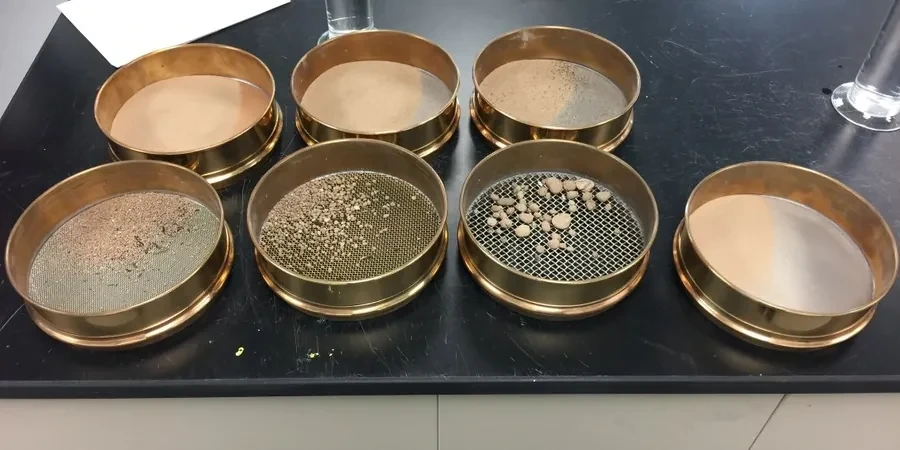
Mechanical Sieve Analysis (Coarse Fraction)
This procedure quantifies the gravel and sand fractions retained on the No. 200 sieve. The sample is oven-dried, washed over the 75 µm sieve to remove fines, then mechanically shaken through a stack of sieves conforming to ASTM E11 specifications. Results are reported as percent passing by weight, providing the gradation parameters—D10, D30, D60—needed to compute the coefficient of uniformity (Cu) and curvature (Cc). This data is essential for filter design, drainage aggregate specification, and concrete aggregate compliance in Saanich projects.
Hydrometer Analysis (Fine Fraction)
For the silt and clay fraction passing the No. 200 sieve, the hydrometer method applies Stokes’ Law to measure particle settling velocity in a dispersed suspension. Temperature-corrected readings are taken at 2, 5, 15, 30, 60, 250, and 1440 minutes using a 152H hydrometer. This test is indispensable for classifying fine-grained soils in the glacial marine deposits found across the Saanich Peninsula and for predicting the consolidation and frost-heave behavior that governs foundation performance in this region.
Typical parameters
Quick answers
How much does a grain size analysis cost in Saanich?
For a combined sieve and hydrometer analysis on a single sample, the cost typically ranges from CA$140 to CA$240, depending on the sample condition and whether the material is predominantly coarse or fine-grained. Bulk pricing is available for projects requiring 10 or more samples.
What sample mass is required for the test?
The ASTM D6913 standard specifies a minimum dry mass based on the maximum particle size. For soils with gravel up to 19 mm, approximately 500 grams is sufficient. For fine-grained soils where the hydrometer analysis is needed, a minimum of 200 grams of material passing the No. 10 sieve is required. The team can advise on sample splitting during the field collection.
How long does it take to get results for a Saanich project?
Standard turnaround is 3 to 4 business days from sample receipt. The hydrometer portion requires a 24-hour sedimentation period per CSA + ASTM D422, so the full combined analysis cannot be completed in less than 24 hours. Expedited service with overnight hydrometer reading and same-day reporting is available for time-sensitive construction schedules.