We were called out to a site off the Pat Bay Highway last spring where a developer had cut into a slope of Vashon till to make room for a three-story mixed-use building. The exposed face stood nearly 4 meters high and the upper layer was looser than anyone expected. That is the reality of retaining wall design in Saanich—you deal with glacial deposits that can shift from dense, overconsolidated till to loose ablation material in a matter of meters. A standard precast block wall would have been a gamble. We ran the numbers for an L-shaped cantilever wall with a key, and paired that analysis with a slope stability study to confirm the global factor of safety under seismic loading. On the Peninsula, NBCC 2020 design spectra and site class D assumptions drive lateral earth pressures higher than a textbook problem ever suggests.
A retaining wall in Saanich must resist both active earth pressures at rest and the NBCC seismic increment—ignore either and the wall becomes a liability.
Method and coverage
Regional considerations
Saanich grew outward from the Douglas Street corridor and spilled into the hillsides around Elk Lake and Prospect Lake during the 1970s and 80s. Many of those older subdivisions were built with minimal cut-fill engineering, and the retaining walls from that era are now reaching the end of their service life. We see cracking, tilting, and drainage failure in walls that were never designed for today's seismic code. The risk is compounded by winter saturation: the silty till matrix holds water, pore pressures build behind the wall, and a moderate earthquake can trigger a translational failure. A new retaining wall design here must account for hydrostatic pressure assumptions, backfill permeability, and the potential for liquefaction in any loose sand lenses. We also check global stability because Saanich slopes can extend well beyond the wall footprint and mobilize deeper failure surfaces than the wall geometry alone would suggest.
Standards that apply
NBCC 2020 (Part 4, Structural Design), CSA A23.3:19 (Design of Concrete Structures), ASTM D1586-18 (Standard Penetration Test), FHWA-NHI-10-024 (Soil Nail Walls), Eurocode 7 (EN 1997-1:2004, for comparison with local practice)
Other technical services
Geotechnical Investigation for Walls
Boreholes, test pits, and lab testing to define the soil profile, shear strength, and groundwater conditions behind the proposed wall alignment.
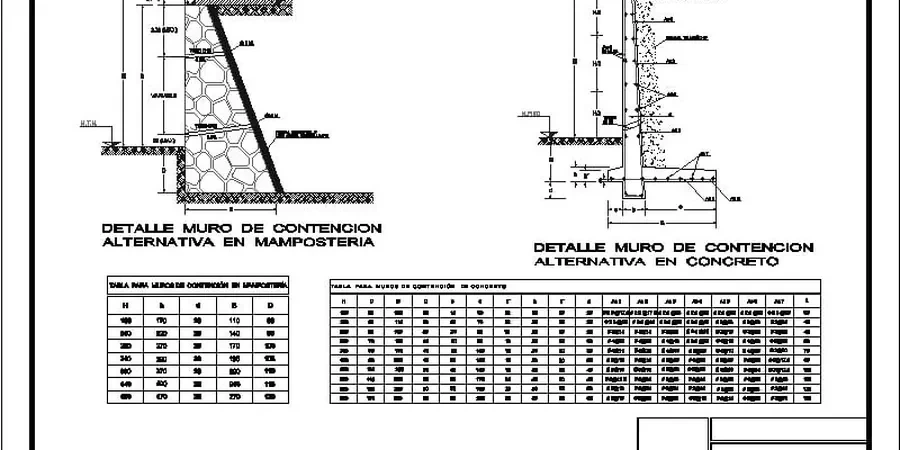
Gravity and Cantilever Wall Design
Reinforced concrete wall sections designed for overturning, sliding, bearing capacity, and internal structural forces per CSA A23.3.
Anchored and Soil-Nailed Walls
Design of tieback anchor systems and soil nail walls for cuts exceeding 5 meters, including corrosion protection and long-term monitoring plans.
Construction Review and Instrumentation
Field review during excavation and backfill placement, plus inclinometer and piezometer installation when wall performance must be verified post-construction.
Typical parameters
Quick answers
What is the cost range for retaining wall design in Saanich?
For a typical residential or light commercial wall under 3 meters retained height, the geotechnical investigation and structural design package runs between CA$1,600 and CA$5,360. The spread depends on access constraints, the number of boreholes required, and whether a seismic analysis beyond the standard equivalent-static method is needed.
Do Saanich walls need a building permit?
Yes. The District of Saanich requires a building permit for retaining walls over 1.2 meters in height, and walls that support a surcharge such as a driveway or building require a professional engineer's stamp. We prepare the sealed drawings and the letters of assurance that accompany the permit application.
How do you handle drainage behind the wall?
We specify a free-draining granular backfill with less than 5 percent fines, a continuous strip drain or weep holes at the base, and a filter fabric to prevent clogging. For walls on slopes we often add a subdrain system that daylights to a catch basin to prevent hydrostatic pressure buildup.
What seismic loading do you use for Saanich?
We apply the NBCC 2020 seismic hazard values for the Victoria metropolitan area, typically site class C or D depending on the borehole shear-wave velocity data. The lateral earth pressure increment from seismic loading is calculated using the Mononobe-Okabe method, and we check both external and internal stability under the factored loads.