Vibrocompaction design in Saanich must directly address the performance-based criteria of the current NBCC and the seismic hazard values for the Juan de Fuca region. The municipality sits at 48.45°N, a latitude where the subduction zone threat is not abstract; it governs allowable bearing pressures and deformation limits. Our approach uses CPT-based pre-design profiling to quantify relative density targets, typically achieving Dr > 70% for sites underlain by the Vashon Drift or advance outwash. We then specify probe spacing and energy input, referencing ASTM D6066 for method consistency, to ensure the final Improvement geometry matches the required equivalent clean-sand blowcount.
This is not a one-size template. Each design in Saanich accounts for the overconsolidated crust often present above the loose zone, a signature of the last glacial retreat. The result is a verified, densified matrix that reduces total and differential settlement to acceptable limits under the design earthquake.
A vibrocompaction design calibrated to a site-specific CPT profile can raise the factor of safety against liquefaction from 0.8 to over 1.3 in Saanich's advance outwash deposits.
Method and coverage
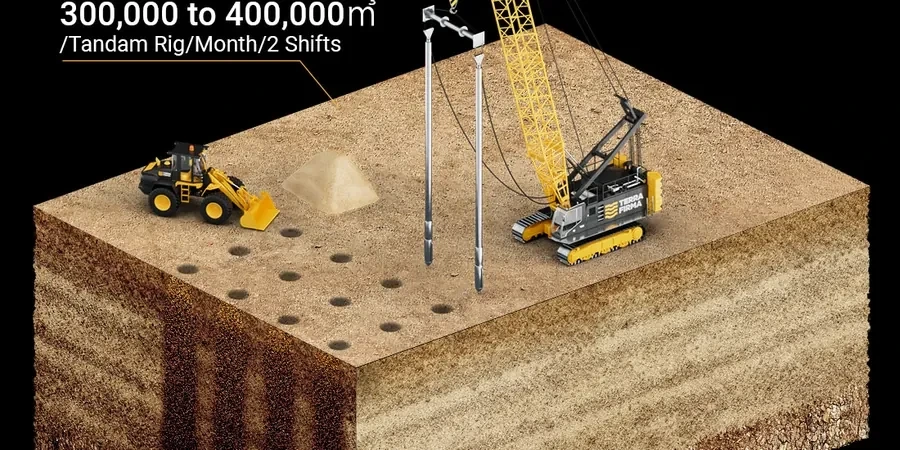
The method is depth-limited by the vibroflot's follower tube capacity, typically reaching 18 to 22 meters in the local Esquimalt Formation sands. Energy is delivered via horizontally oscillating probes, and the resulting settlement trough is monitored with laser levels. Backfill is rarely needed for clean sands; the process relies on the collapse of the soil structure and re-densification under vibration. We validate the design with post-treatment penetration tests, ensuring the achieved stiffness matches the seismic demand for the site's NEHRP Site Class.
Regional considerations
Post-war expansion in Saanich pushed residential subdivisions onto the Cordova Bay lowlands and the Shelbourne Valley, where loose, saturated sands were mapped decades later as high-liquefaction-susceptibility zones. A design that skips site-specific seismic site response analysis leaves the owner exposed to foundation damage from cyclic softening. The risk is not just structural tilt; it is the loss of bearing capacity during a Cascadia interface event, which can generate shaking durations exceeding 60 seconds.
Our designs incorporate the Seed-Idriss simplified procedure, updated with NCEER recommendations, to calculate the liquefaction potential index (LPI) across the treatment depth. We target an LPI of zero or near-zero post-improvement. Without this, utility trenches and shallow footings on untreated ground can undergo differential settlements of 10 to 30 cm, a cost multiplier no contractor wants to face after the ground stops shaking.
Standards that apply
NBCC 2020, ASTM D6066-11, NCEER 2001 (Youd-Idriss)
Other technical services
Pre-treatment Seismic Site Assessment
We conduct MASW surveys to measure Vs30 and establish the initial Site Class. This data feeds the ground response analysis, defining the cyclic stress ratio profile needed to calibrate the densification grid.
Post-treatment Verification Program
After probe installation, we execute a series of CPT soundings at centroid and edge-of-grid locations. The measured qc1Ncs values are plotted against the design target to confirm that the entire treatment volume meets the specified relative density.
Typical parameters
Quick answers
What is the typical cost range for a vibrocompaction design in Saanich?
Design fees for a vibrocompaction project in Saanich generally range from CA$2,190 to CA$7,690, depending on the treated area, depth requirement, and the number of post-treatment verification tests specified.
Which Saanich soil formations respond best to vibrocompaction?
The clean to slightly silty sands of the advance outwash and the Vashon Drift are ideal candidates. Soils with fines content exceeding 15% require careful evaluation, as silt can dampen the vibratory energy and reduce the achieved radius of influence.
How do you verify the design after the vibroflot is removed?
We perform a statistical comparison of pre- and post-treatment CPT tip resistance. The design is confirmed when every sounding within the treatment zone exceeds the calibrated qc1Ncs threshold, and the calculated post-improvement LPI is zero across the site.