The wet winters and dry summers of the Saanich Peninsula create a unique challenge for earthwork contractors. One week the site is saturated from a Pacific frontal system, the next it's bone dry — and both extremes wreak havoc on compaction. Getting the moisture content right during placement is the difference between a subgrade that holds for decades and one that settles within two seasons. That's where a properly executed Proctor test becomes indispensable. Whether your project involves trench backfill along the Patricia Bay Highway or site preparation for a subdivision near Elk Lake, the standard or modified Proctor establishes the target density and optimum moisture content that your crew needs to hit. Without it, you're compacting blind, and in the glacially overridden soils that dominate Saanich, that's an expensive gamble.
A five percent deviation below maximum dry density can double the settlement potential in a saturated glacial till — the Proctor curve is your compaction roadmap.
Method and coverage
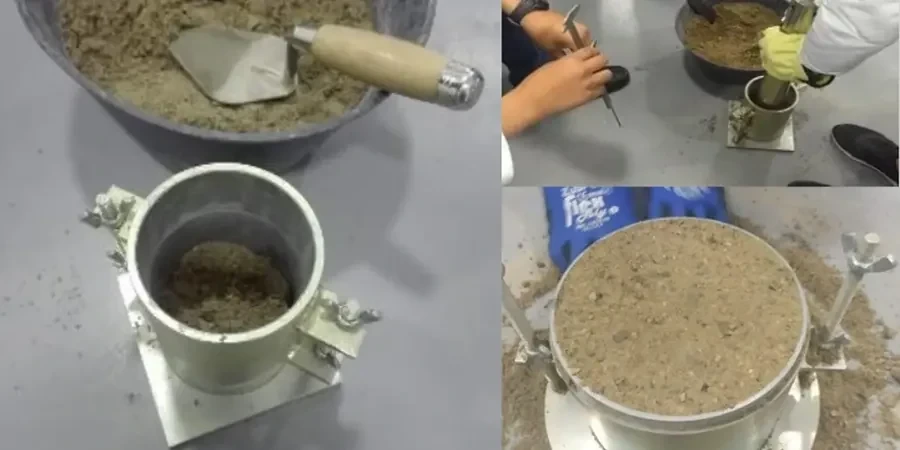
We run both ASTM D698 (Standard Proctor) and ASTM D1557 (Modified Proctor) in our lab, selecting the appropriate compactive effort based on the structural loading and the type of equipment your crew is using. For flexible pavement subgrade on municipal roads, the CBR road test often pairs with a modified Proctor to correlate strength with density. In deeper structural fills, where vibrocompaction may be part of the Improvement strategy, we'll reference the Proctor curve alongside vibrocompaction monitoring data to verify that target densities are achievable with the equipment on site.
Regional considerations
I recall a project off West Saanich Road — a modest two-storey commercial building with a parking lot extension. The contractor placed structural fill over a layer of silty marine clay without running a Proctor test first, relying on visual inspection and knowledge from drier sites up-island. Within eighteen months, differential settlement cracked the asphalt and tilted a retaining wall footing. The root cause? The fill was compacted three percent wet of optimum, trapping pore pressure that the clay couldn't dissipate. The repair bill far exceeded what a proper compaction control program — starting with a standard Proctor and backed by field density testing — would have cost at the outset. Saanich soils don't forgive shortcuts, and the moisture-density relationship isn't something you guess at.
Standards that apply
ASTM D698, ASTM D1557, AASHTO T-99, AASHTO T-180, BC Building Code (referencing NBCC)
Other technical services
Standard and Modified Proctor Testing
Laboratory determination of the moisture-density relationship using the appropriate compactive effort for your project. Includes full curve with maximum dry density and optimum moisture content, suitable for specification compliance under MMCD or BC Ministry of Transportation standards.
Field Compaction Control Package
Combining the lab Proctor test with on-site nuclear density gauge or sand cone testing to verify that placed fill meets the specified percentage of maximum dry density. We handle the full loop — from lab reference to field verification — so your compaction record is defensible and complete.
Typical parameters
Quick answers
What's the difference between Standard and Modified Proctor tests?
The difference is the compactive effort applied in the lab. Standard Proctor (ASTM D698) uses a 5.5-lb hammer dropped 12 inches, simulating lighter compaction equipment. Modified Proctor (ASTM D1557) uses a 10-lb hammer dropped 18 inches, replicating heavier modern rollers. Modified typically yields a higher maximum dry density and a lower optimum moisture content. For most Saanich building pads and trench backfill, Modified Proctor is specified; Standard may be adequate for landscaping fills or low-load areas.
How much does a Proctor test cost in Saanich?
A single-point Proctor test (Standard or Modified) typically ranges from CA$130 to CA$270, depending on soil type and whether we need to run the full five-point curve or a reduced set. If you need both the lab Proctor and field density testing as a package, we can offer a combined quote based on the number of lifts and area.
How long does it take to get Proctor test results?
Standard turnaround is two to three business days after we receive the soil sample. If you're on a tight schedule — say, weather is closing in and you need to finish compaction before the rain hits — we can often expedite to next-day results. The key is getting us a representative bulk sample early, ideally during site stripping, so the curve is ready when compaction starts.
What soil material do you need for the test?
We need about 25 to 30 kg of representative material for a full five-point curve, less if we're doing a one-point verification against an existing family of curves. The sample should be taken from the borrow source or the lift being placed, not from the surface crust. For Saanich tills with cobbles, we may need to scalping oversize material on the 3/4-inch sieve and apply a rock correction per ASTM D4718. More info.