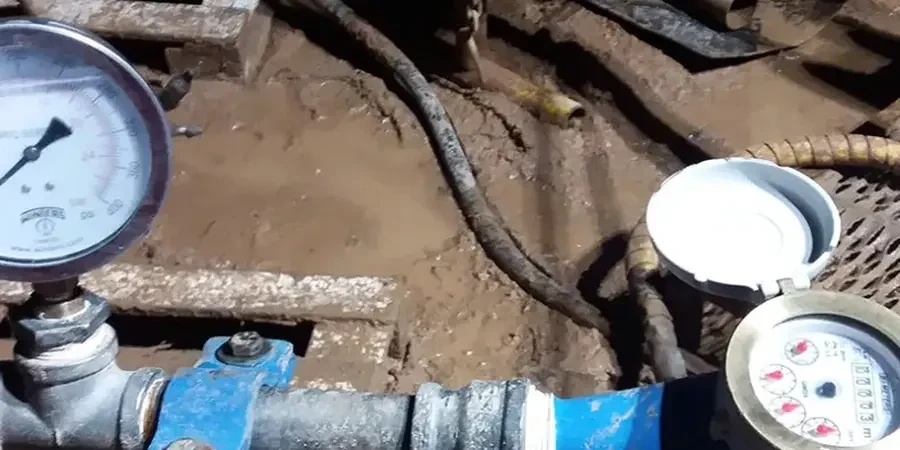
A steel slotted casing is lowered into a Saanich borehole, followed by a pneumatic packer inflated against the weathered till. This is the setup for a Lugeon test. Water is pumped in stages at controlled pressure, and the volume absorbed by the rock mass is recorded every minute. For the Lefranc variant, a simple cavity is isolated below the casing tip to measure hydraulic conductivity in soil. The equipment must be calibrated on-site. Pressure transducers and flow meters are checked against barometric readings because Saanich's elevation shifts from sea level at Cordova Bay to over 100 meters near Elk Lake. CPT testing can offer a continuous soil profile before selecting test intervals, and triaxial analysis on Shelby tube samples gives lab permeability values for comparison with the field data.
A single Lugeon value without understanding the Saanich fracture network is just a number. Context from glacial history turns it into a design parameter.
Method and coverage
Regional considerations
A project on the dense lodgement till near Royal Oak faces a completely different seepage regime than one on the glaciofluvial sands of the Blenkinsop Valley. The till can have a permeability as low as 10⁻⁷ cm/s, while the valley sands may exceed 10⁻³ cm/s. Assuming a single representative value across a Saanich site without staged testing is a critical error. We have seen excavation designs fail because a perched water table in a thin sand lens was not detected by a properly isolated Lefranc test. The Lugeon test in fractured granodiorite bedrock—common in the Highlands area—reveals the risk of concentrated flow paths. Ignoring these paths leads to grout take underestimation. Our approach uses packer isolation to test each distinct lithological unit separately, preventing costly groundwater control failures during construction.
Standards that apply
ASTM D4630-19, ASTM D6391-11, USBR 7300-89
Other technical services
Lefranc Test in Overburden
Variable and constant head tests in soil boreholes. We isolate specific strata in Vashon till or Quadra sands to measure hydraulic conductivity for dewatering and slope stability analysis.
Lugeon Packer Test in Rock
Multi-stage pressure testing in fractured granodiorite using pneumatic packers. We apply the Houlsby criterion to define the grouting strategy for dams and deep shafts.
Falling-Head Slug Tests
Rapid assessment of permeability in existing standpipe piezometers. This method verifies the zone of influence for dewatering wells across Saanich's varied glacial deposits.
Typical parameters
Quick answers
What is the difference between a Lefranc test and a Lugeon test?
A Lefranc test measures hydraulic conductivity in soil by injecting or extracting water from an open borehole cavity. It is typically a single-stage test. A Lugeon test uses an inflatable packer to isolate a section of rock core and applies water pressure in five stages. It assesses the hydraulic behavior of fractures under stress, not just a simple k-value.
How long does a staged Lugeon test take on a Saanich site?
A standard five-stage Lugeon test in a 3-meter interval takes approximately 90 to 120 minutes to complete, including packer inflation, pressure stabilization, and flow recording. The time can extend if the rock mass is highly fractured and requires longer stabilization at each pressure step.
What is the typical cost range for a field permeability testing program in Saanich?
A targeted testing program involving one or two Lefranc tests or a single Lugeon packer test generally falls between CA$770 and CA$1,580. The final cost depends on the number of test intervals, mobilization distance, and the type of drill rig required to access the bedrock.
Which ASTM standard governs the Lugeon test procedure?
The procedure follows ASTM D4630-19, Standard Test Method for Determining Transmissivity and Storage Coefficient of Low-Permeability Rocks by In Situ Measurements Using the Constant Head Injection Test. We also reference USBR 7300-89 for the interpretation of Lugeon values.